2 VOICES½ CYCLE APART
One voice each side, opposite in phase: as one delay grows the other shrinks. The classic stereo chorus, and the widest image for the fewest voices.
A chorus built around one LFO, not several unrelated ones. Every voice reads the same delay line, offset by its own share of the cycle and detuned outward from centre, so the ensemble moves together and spreads symmetrically across the stereo field.
The VOICE BRAID at the centre of the panel is the delay line, drawn by the same maths that runs the audio.
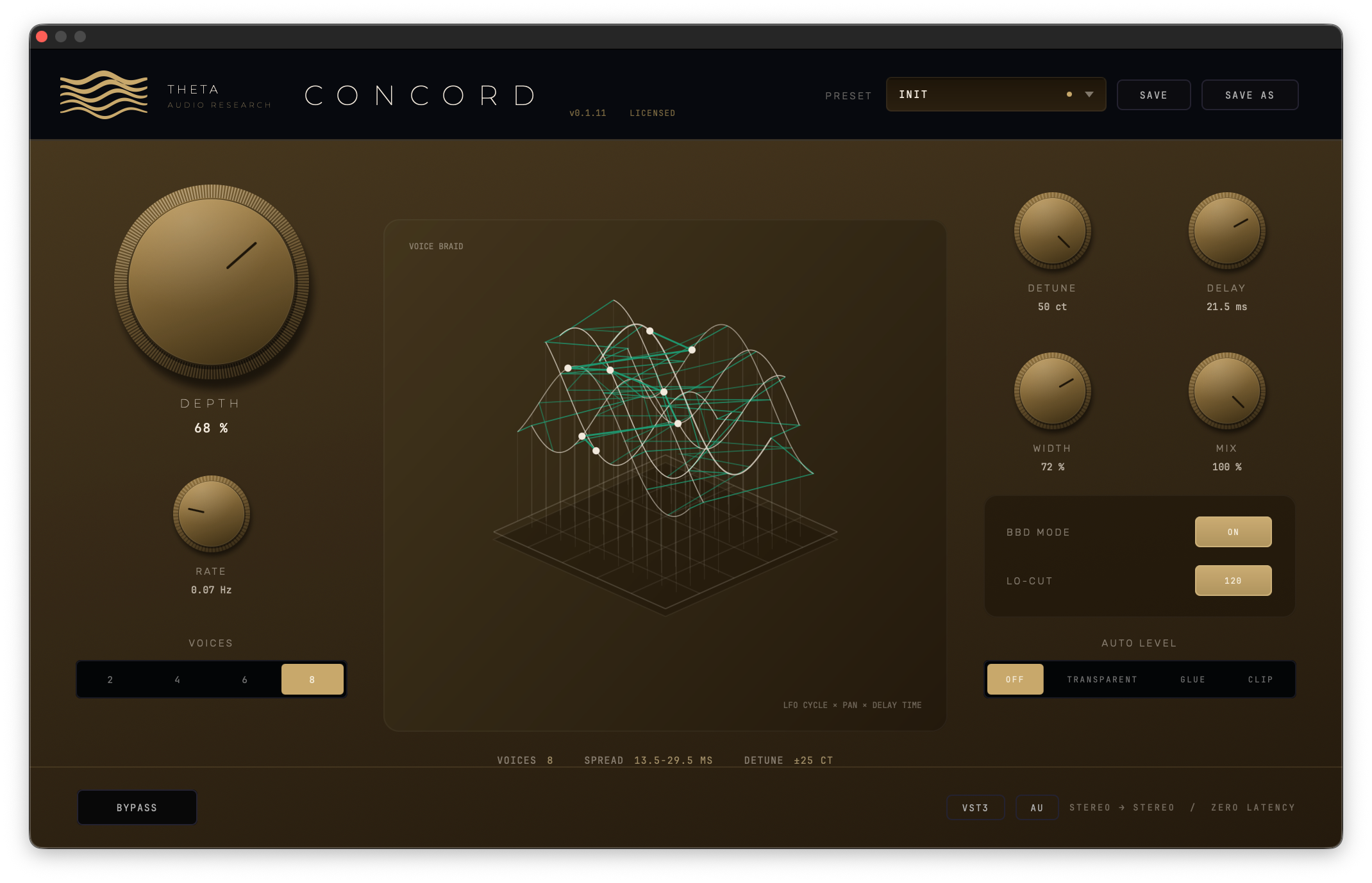
A chorus is a copy of the signal, delayed by a few milliseconds, with that delay sweeping slowly up and down. While the delay grows the copy plays a touch flat; while it shrinks, a touch sharp. Blend it back with the original and the two drift in and out of tune with each other the way a section of players does. That drift is the chorus.
One copy wobbles. Several copies, sweeping out of step, shimmer. The question is how they are kept out of step. Separate LFOs wander into each other and the ensemble pulses. CONCORD gives every voice the same LFO and staggers it by an exact share of the cycle, so at any instant the voices are spread evenly through it.
The input is summed to mono and written into one delay line. VOICES reads two, four, six or eight taps off it. DELAY sets where the taps sit, DEPTH how far they swing, RATE how fast. DETUNE stretches alternate voices' delays up and down around centre, so no two taps land together, and WIDTH fans them out across the stereo field, odd voices to one side, even to the other.
BBD and LO-CUT shape only the wet path. MIX blends it with the input, which is never delayed, and AUTO LEVEL takes the volume out of the comparison. One header owns the swing; the audio, the display and the test harness all call it, so the picture cannot drift from the sound.
Left and right are averaged into one delay line, so every voice is reading the same material, and a mono track feeds it directly.
Two to eight taps read the line with third-order interpolation, each swept by the shared LFO at its own offset.
Each voice gets a fixed place in a constant-power stereo spread, and the sum is scaled by 1/√N so more voices do not mean more level.
BBD rolls the wet path off like a bucket-brigade chip, LO-CUT keeps it out of the low end. The dry signal is not touched.
MIX blends wet and dry, then AUTO LEVEL matches the loudness to the input and the ceiling holds the peaks.
This is CONCORD's voice engine running in your browser, with the same formulas as the plug-in. On the left is the VOICE BRAID as the panel draws it. On the right, the top trace is every tap's delay time over one LFO cycle, with the playhead where the LFO is now; underneath, each voice's place in the stereo field, rising and falling as its delay does. PITCH SWING is how far the sweep bends a voice's pitch at its fastest.
Each picture shows the shared LFO as a ring with one dot per voice, a fixed share of the cycle apart, and beside it each voice's place in the stereo field, lifting as its delay grows. Changing VOICES dips the wet path for 8 ms, swaps the count at the bottom of the dip and comes back up, so even a stepped control does not click.
One voice each side, opposite in phase: as one delay grows the other shrinks. The classic stereo chorus, and the widest image for the fewest voices.
The default. Two pairs, the inner one near centre and the outer one at the edges, so the ensemble has a middle as well as width.
Three pairs stepping outward. The sweeps overlap enough that the movement smooths into a sheen rather than a wobble.
Four pairs, an eighth of a cycle apart: an ensemble. Summed at 1/√8, so it is denser, not louder.
Press SHOW IN THE LAB on a card and the braid lab above sweeps that control through its range. Every control automates, the continuous ones glide, and the switches crossfade, so nothing clicks. Double-click a knob to return it to its default.
0 to 100 %, default 55. Up to 11.3 ms of swing at the top, 6.2 ms at the default. The swing is held to the room the delay line has, so even a short DELAY sweeps a clean, full sine with no dead zone at the bottom of the knob.
0.02 to 8 Hz, default 0.42. Skewed so the slow end, where most chorus lives, gets most of the knob: about 1 Hz at mid-throw. One rate for every voice, because every voice is the same LFO.
2, 4, 6 or 8, default 4. Each voice is a tap off the same line, a 1/N share of the cycle from the next. The sum is scaled by 1/√N, so the count changes the texture, not the level.
0 to 50, default 14. Alternate voices' delays are stretched up and down by a ratio of half that many cents, so the pairs sit at different depths of the line and their taps never land on the same sample.
1 to 40 ms, default 14. Short settings flange and thicken; long ones open into a doubled, ensemble sound. The braid's height is this number, so you can see every voice's delay in milliseconds.
0 to 100 %, default 78. Odd voices to one side, even to the other, each pair a step further out, on a constant-power law. At 0 every voice is centred; at 100 the outer pair sits at the edges.
0 to 100 %, default 42. A linear crossfade against the input, which is never delayed, so the dry path has no latency of its own. At 0 CONCORD nulls against its input.
BBD rolls the wet path off around 5.2 kHz, the bandwidth of a bucket-brigade chip. LO-CUT takes the wet path out below 120 Hz, so the low end stays exactly as you recorded it. Both crossfade, so neither clicks.
VOICE BRAID is not a level meter and not an animation. Read left to right, it is one full LFO cycle. Read front to back, it is pan. Read up, it is delay time: the ribbon's height at any point is exactly what that voice is doing to the signal at that instant. The swing it draws comes from the same function the audio calls, so the picture cannot drift from the sound.
The geometry comes from the knobs. The brightness comes from the audio. CONCORD measures, every block, what the chorus is actually doing to your signal and what each voice contributes. In silence the braid rests as a faint ghost of the settings and the playhead all but disappears; with signal it lights, and each playhead dot swells with that voice's real level. At MIX 0 or under BYPASS it rests, because the chorus is doing nothing.
Under the display, SPREAD prints the shortest and longest delay any voice reaches, in milliseconds. It never reports a delay the engine cannot produce.
CONCORD loads on mono tracks, mono in and stereo out, so it is on the insert menu of a mono guitar, bass or vocal track in Pro Tools and Logic without a stereo bus in between. The engine was reading a mono sum all along; the mono input simply feeds it directly.
The dry path stays where you put it: at MIX 0 or under BYPASS the mono signal comes out centred on both sides, not on the left only. The voices fan out around it by WIDTH.
The EXPORT IR button beside BYPASS saves the impulse response of the current settings: a 24-bit stereo WAV, 250 ms long, at your session's sample rate. Load it into a convolution reverb or an IR loader and you have CONCORD as it sounds with the LFO held still: a frozen chorus voicing for a sampler, a template, or a collaborator without the plug-in.
The file is rendered through a separate copy of the engine, so the audio that is playing is never touched. BYPASS and AUTO LEVEL are left out, since a level follower has no impulse response, and the output stage's lookahead is taken off the front: the dry impulse lands on the first sample. The file name comes from the preset and the rate, and the save dialog warns before replacing a file.
The trace is the first 60 ms of the impulse response of the braid lab's settings, computed sample by sample at 48 kHz: the dry impulse at zero and one tap per voice, left in cream above the line and right in teal below it.
A chorus changes level as you add voices and push MIX, and louder always sounds better for about a second, so an A/B made while you dial it in is rigged. AUTO LEVEL matches the output back to the level coming in, so your ear compares the chorus and not the gain. Every release build checks that TRANSPARENT and GLUE hold a louder patch within 1 dB of its input.
Four positions at the bottom right of the panel. TRANSPARENT rides the gain slowly and leaves the sound alone. GLUE adds a gentle 2.5:1 compressor, the way a bus compressor sits on a mix. CLIP drives 9 dB into the ceiling, loud on purpose. In every working mode no sample passes −0.3 dBFS, and a true-peak stage keeps what lies between the samples under 0 dBTP on a standard meter.
OFF is the default, and sessions and presets made before AUTO LEVEL existed open with it off and sound exactly as they did. It stays working under BYPASS, so the level is already matched the moment you release it, and changing mode fades over 10 ms so it never clicks.
CONCORD runs as a fully working trial for fourteen days, and the licence line in the header counts down the days left. After that, a computer that has never been activated goes silent until a licence is activated; in GarageBand and other sandboxed hosts it keeps playing. A licence unlocks the same install in place, no reinstall.
An activated copy is never silenced by a licence problem. After a hardware change, or with the activation server out of reach, it keeps making sound and shows a banner asking you to reactivate.
Click the licence line, paste the key from your purchase email and press ACTIVATE. Activation needs the internet once, and one activation covers every user account on that Mac, so a shared studio machine uses one seat, not one per login. One licence covers three computers, and DEACTIVATE THIS COMPUTER frees a seat so you can move CONCORD without writing to us.
After activation CONCORD works offline. When it can reach the internet it checks about once a week that the Mac still holds its seat, and no result of that check, and no lack of a connection, ever stops the sound.
Two voices for the classic stereo chorus, eight for a string-machine ensemble. SLOW ENSEMBLE and DETUNE PAD are the places to start.
Straight onto the mono track in 1.0. LO-CUT keeps a bass's fundamental untouched while the chorus moves above it.
Low DEPTH and a long DELAY for a doubled, wider vocal, with AUTO LEVEL so the wider version does not win just by being louder.
EXPORT IR prints a voicing for a convolver or a sampler. Short DELAY and high DEPTH tip CONCORD into flanging when a part needs to move.
| TYPE | Multi-voice stereo chorus (insert) |
|---|---|
| VOICES | 2 · 4 · 6 · 8 taps off one delay line, one shared LFO offset by 1/N per voice, summed at 1/√N |
| CONTROLS | DEPTH · RATE · VOICES · DETUNE · DELAY · WIDTH · MIX · BBD · LO-CUT · AUTO LEVEL · BYPASS · EXPORT IR |
| RANGES | DEPTH 0–100 % (up to 11.3 ms swing) · RATE 0.02–8 Hz · DELAY 1–40 ms · DETUNE 0–50 · WIDTH 0–100 % |
| PROCESSING | Third-order Lagrange interpolated delay line · BBD 5.2 kHz roll-off and 120 Hz LO-CUT on the wet path only |
| OUTPUT | AUTO LEVEL: OFF · TRANSPARENT · GLUE · CLIP · samples to −0.3 dBFS, true peak under 0 dBTP |
| LATENCY | 32 samples at every rate and in every mode, reported to the host |
| CHANNELS | Mono in, stereo out · stereo |
| EXPORT IR | 24-bit stereo WAV, 250 ms, at the session sample rate |
| PRESETS | Six factory presets; your own with SAVE and SAVE AS, kept in the plug-in state so they travel with your session |
| LICENCE | 14-day full trial · one licence, three computers · one activation covers every user account on a Mac · activate once online, then runs offline · perpetual |
| FORMATS | VST3 · Audio Unit · AAX (Pro Tools) |
| SYSTEM | macOS 11 or later · Apple Silicon and Intel (universal) · Developer ID signed, notarized |
CONCORD shares its AUTO LEVEL output stage and true-peak ceiling with the rest of the Alchemy Index, so level-matched A/Bs work the same way across THETA's plug-ins.
No reverb tail, no feedback, nothing recirculating. A single-purpose chorus and the small set of controls that make one usable on anything from a mono guitar to a mix bus.
CONCORD 1.0 is available now. Every voice count, EXPORT IR, mono tracks, the full panel, nothing withheld.
Launch sale. Use code ALCHEMY50 at checkout. The trial is the same installer, unlicensed for fourteen days; a licence unlocks it in place, no reinstall.