Geometric stereo processor · Version 1.0

EUCLID

Turn sound into geometry.

EUCLID splits your stereo mix into 513 frequencies and gives each one a point on a plane: where it sits in the spectrum one way, how wide it is the other. Then it moves the whole plane at once. Shear it, scale it, rotate it, and every frequency's width follows the geometry.

The point's second coordinate is not thrown away. It sets that frequency's own delay tap, so one turn of ROTATION trades width for time across the whole spectrum. The Mid is never touched, so the mix folds to mono exactly as it went in.

VST3AUAAXmacOS · Apple Silicon and IntelWindows · VST3
FIELD · FACTORY PRESETS
TURN · TILT -ROTATION -PRESET FIELD SPIN
DRAG THE CUBE TO TURN IT · DOUBLE-CLICK TO RESET
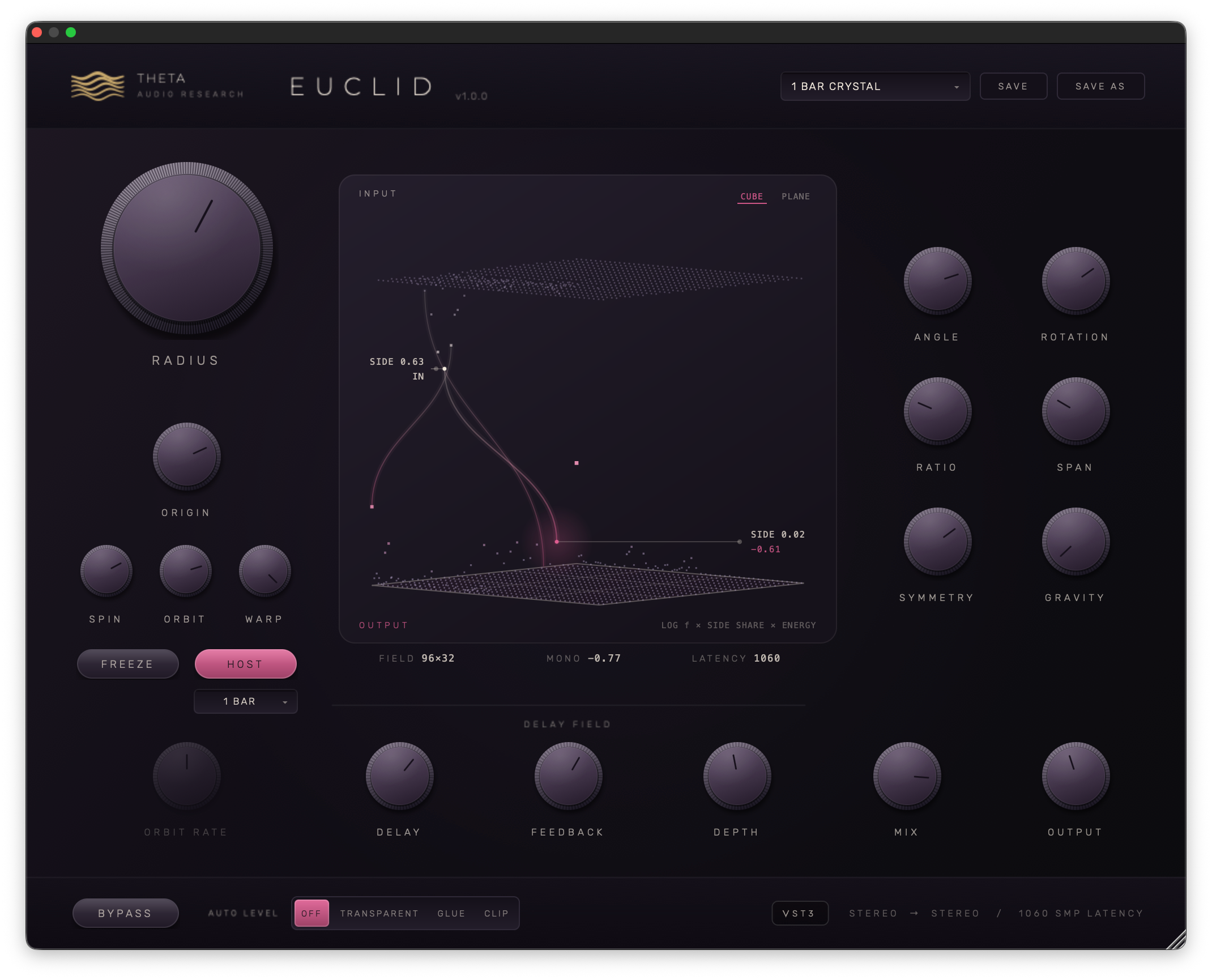
The EUCLID panel: RADIUS and ORIGIN on the left with SPIN, ORBIT and WARP under them and the FREEZE and SYNC pills, the field display in the middle with the input floating over a floor plate, ANGLE, ROTATION, RATIO, SPAN, SYMMETRY and GRAVITY on the right, the DELAY FIELD row with ORBIT RATE, DELAY, FEEDBACK, DEPTH, MIX and OUTPUT along the bottom, and BYPASS, AUTO LEVEL and the trial line in the footer
Before and after
Sound on
How it works

Every stereo signal can be split into Mid, what the two speakers share, and Side, what makes them differ. Side is the width. A wide pad is mostly Side; a kick drum has almost none. Most stereo tools turn the Side up or down as one block, or in three or four fixed bands.

EUCLID looks at the Side of each of 513 frequencies separately and places every one on a plane. Across is where the frequency sits, in octaves either side of the ORIGIN you choose. Up is its Side share: how much of its energy is width. Then one transform moves all of them together.

p′ = R(rotation) · Scale(radius) · Shear(angle) · p

ANGLE shears frequency into width, so one side of ORIGIN widens while the other narrows. RADIUS scales the whole field: at 0 everything folds to mono, at 4 the Side is 12 dB up. ROTATION turns the plane, so width starts to depend on frequency and position starts to depend on width.

The new height becomes the frequency's new Side. The new across position becomes its delay time. Both coordinates are heard, and at the neutral settings the output nulls against the input at −138.98 dB.

IN STFT1024 · HOP 256 MID / SIDEPER BIN p = (x, y) → p′SHEAR · SCALE · ROTATERATIO · SPAN · SYMMETRYGRAVITY SIDE ONLYSPIN · WARP · FREEZE TAP PER BINSET BY x′ iSTFTOLA MIX DRY · DELAYED 1024 SAMPLES TO MATCH OUTTRIM AUTO LVL−0.3 dBTP ORBIT SYNC ORBIT SWINGS ROTATION · SYNC LOCKS ORBIT AND DELAY TO TEMPO
  1. 1SPLIT

    A 1024-point transform every 256 samples cuts the stereo signal into 513 frequencies, and each is split into its Mid and its Side.

  2. 2PLACE

    Each frequency becomes a point: octaves from ORIGIN across, Side share up. GRAVITY can bend the share first.

  3. 3MOVE

    Shear, scale and rotate move every point at once. The new height is the new Side, rebuilt with its own phase.

  4. 4DELAY

    The new across position sets the frequency's delay tap. DEPTH brings the echoes in, FEEDBACK lets them regenerate.

  5. 5LEVEL

    MIX blends against the dry signal, delayed so the two line up, then OUTPUT trims and AUTO LEVEL holds the loudness and the −0.3 dBTP ceiling.

The field lab

This is EUCLID's transform running in your browser on the same mix as the hero display. On the left is the plane itself: blue dots are where each frequency starts, gold dots where the geometry puts it, and the pink lattice is the plane being moved. Height is width; across, after the move, is delay time. On the right is what that does to the sound: the Mid spectrum in grey, the Side going in and the Side coming out, and under them the delay tap each frequency now has.

SIDE @ 100 Hz-@ 1 kHz-@ 10 kHz-MONO-TAPS-
INPUT POINT · SIDE INOUTPUT POINT · SIDE OUTTHE MOVED PLANE · DELAY TAPTAPS AT DELAY 320 ms · MAGNITUDE MODEL
The geometry

Each picture is the plane on its own, one operation at a time, sweeping back and forth. Dots are frequencies, coloured from low (blue) to high (gold); the pink cross is ORIGIN. The order matters: shear first, then scale, then rotate, so ANGLE decides the slope that RADIUS then stretches and ROTATION then turns.

ANGLESHEAR · ±80°

Frequency is tilted into width. Points above ORIGIN climb, points below drop, and the slope is the tangent of the angle: at 45° a frequency one field unit above ORIGIN gains 0.9 of Side share. The quickest route to a mix that gets wider as it goes up, or narrower.

RADIUS · RATIOSCALE · 0–4 · 0.25–4

RADIUS scales the plane from its centre. With nothing else moved it is exactly a Side gain: 0 is full mono, 1 leaves it alone, 4 is +12 dB of width. RATIO splits it into two scales, across by RATIO and up by one over RATIO, so you choose how much the field cares where a frequency is against how wide it already was.

ROTATIONROTATE · ±90°

The plane turns about its centre. Some of each point's frequency position becomes width, and some of its width becomes position, which is delay time. Turn it and the high end can open while the low end collapses, and the echoes fan out by how wide each frequency was.

SYMMETRY · GRAVITYMIRROR · BEND

SYMMETRY mirrors the shear about ORIGIN: at 0 the plane tilts one way, at 100 it spreads outward on both sides, so the top and the bottom both widen around a centre that stays put. GRAVITY bends the width before the move. Positive pulls anything not already wide toward mono; negative lifts near-mono material out.

The controls

Press SHOW IN THE LAB on a card and the field lab above sweeps that control through its range. Every control automates and glides over 35 ms. The knob's name shows at rest and its value on hover or while you drag; double-click it to type a value.

RADIUS

0.000 to 4.000, default 1.000, with unity at the middle of the travel. The large knob on the left of the panel. On its own it is an exact Side gain from full mono to +12 dB. With the other moves in play it scales the whole plane, so it decides how far ANGLE and ROTATION reach.

ORIGIN

20 Hz to 20 kHz, default 1 kHz. The frequency that sits at the centre of the field. Shear and rotation turn about it, and it is where the delay taps meet the base DELAY time. Move it and the same geometry lands on a different part of the mix.

ANGLE · ROTATION

ANGLE runs ±80° and shears frequency into width. ROTATION runs ±90° and turns the whole plane, trading frequency position for width and width for delay time. Between them they are most of EUCLID's character, and most of where its delay taps land.

SPAN · RATIO

SPAN is how many octaves make one unit of the field, 0.5 to 10, default 3.5. Small SPAN makes a few octaves feel like the whole plane, so ANGLE and ROTATION bite hard; large SPAN spreads them gently over the spectrum. RATIO, 0.25 to 4, stretches across against up.

SYMMETRY · GRAVITY

SYMMETRY, 0 to 100 %, mirrors the shear about ORIGIN. GRAVITY, ±100 %, curves the Side share before anything moves: positive collapses near-mono material and leaves the wide parts wide, negative does the reverse. Both do nothing at their defaults, to the bit.

MIX · OUTPUT

MIX blends against the dry signal, delayed by exactly the plug-in's latency. It is a linear blend on purpose: the processed signal shares the dry signal's phase, so at neutral settings every MIX position nulls, and anywhere else MIX simply scales the Side change. OUTPUT trims −18 to +12 dB.

The delay field

A point on a plane has two coordinates, and a frequency cannot be moved to another frequency. So EUCLID spends the second one on time. After the move, each frequency's across position sets its own delay tap. At ORIGIN the tap is the DELAY time; above and below it, the taps fan out either side, up to double and down to almost nothing.

ROTATION steers the fan. With the plane straight, the taps follow frequency alone. Turn it and how wide a frequency was starts to decide how late it comes back, so the wide parts of the mix and the centre echo at different times from one knob.

DELAY sets the base time, 5 ms to 1.5 s. FEEDBACK, up to 95 %, feeds each tap back into itself. DEPTH brings the echoes in, and it starts at zero, so the plug-in is a pure stereo processor until you ask for time. The taps are whole steps of the transform, 5.33 ms at 48 kHz, which gives the repeats a granular, spectral grain rather than a clean copy. The echoes cost no extra latency: they live inside the transform EUCLID already runs.

SYNC snaps DELAY to the nearest note value at your host's tempo, straight, dotted or triplet, from 1/32 to a whole bar. At 120 BPM, 320 ms lands on 333 ms, two thirds of a beat.

SYNC AT 120 BPM A HIT EVERY TWO BARS
BASE TAP-SHORTEST-LONGEST-GRAIN5.33 ms
The Side spectrum

SPIN, WARP and FREEZE act on the Side spectrum the geometry has just made, and on nothing else. The Mid passes through untouched at every setting, so a mono fold of EUCLID's output is the input's own mono, and the harness checks it below −138 dB. ORBIT moves the geometry itself. All four sit under ORIGIN on the left of the panel, and all four do nothing at their defaults.

SPIN0–100 % · WIDTH FROM MONO

The one control that makes width from nothing. SPIN feeds a copy of each frequency's Mid in at 90° into its Side, which sounds wide yet cancels exactly when L and R are summed, and turns each Side's phase by an amount the field decides. The sign flips in bands a quarter of a field unit wide, so the image alternates left and right up the spectrum. On a mono source it lifts the Side to −9.8 dB below the Mid; the mono fold still nulls at −140 dB.

WARP±12 st · SIDE IN PITCH

The Side alone moves in pitch, up to an octave either way, while the Mid stays where it was. A phase vocoder reads each frequency's true pitch from how its phase moves between frames and places it where the shift sends it. The width becomes a harmony of the centre: at +12 a 1 kHz Side tone lands on 2 kHz, 72 dB over what is left behind.

FREEZEPILL · SIDE HELD

Press it and the Side spectrum is held as it was at that instant while the Mid plays on: a still stereo halo under live audio. Each held frequency keeps sounding at its own pitch with a little phase drift, so the hold sustains rather than buzzes. It fades in and out over eight transform steps, about 43 ms, and a render is the same every time. Click the picture to press it.

ORBIT · ORBIT RATEROTATION IN MOTION

ORBIT swings ROTATION either side of where the knob sits, up to ±90° at 100 %, once per cycle. Free, ORBIT RATE sets the cycle, 0.25 to 30 seconds. With SYNC on 1/4, 1/2, 1 BAR, 2 BARS or 4 BARS the cycle locks to the host, and while the transport runs it follows the song position, so the field is at the same angle on the same beat every pass of the loop.

The display

The field in the middle of the panel is drawn from the numbers the audio thread has just measured, thirty times a second. Nothing in it is decoration. With no audio coming in, it is an empty lattice, and that is correct.

The field floating at the top is your input, and the one standing on the floor plate is EUCLID's output. There is no box around them. Each is a grid of 96 frequency columns by 32 rows of width, and a cell reaches toward the middle as more energy lands in it. Between them hang 128 threads, one per sampled frequency, from where its width was to where the geometry put it. Every thread leaves its input heading straight down and lands heading straight down, so a frequency the geometry left alone hangs plumb and one it moved swings through an S as wide as the move. Because only the Side changes, the S only swings front to back: that is the DSP, not a limit of the drawing. Once SPIN, WARP or FREEZE are working, the floor shows the Side they made.

Under the card, MONO is the output's measured stereo correlation and LATENCY is what EUCLID reports to the host. The whole display paints in under 2.5 ms at 1× against a 33 ms frame.

  • The top cloud is the input. Left to right is frequency on a log scale with ORIGIN in the middle; front to back is Side share; hanging lower means more energy.
  • The floor cloud is the output, on the same grid. It warms from mauve to the accent pink as energy rises.
  • The threads join each frequency's width going in to its width coming out: fading from cream where it came from to pink where it landed. A straight thread was left alone; one whose S swings back has been widened, and one that swings forward has been narrowed.
  • The callouts follow the loudest thread: its Side share going in on the left, where it landed on the right with how far it moved, and a soft pink glow where it lands. In silence there are none.
  • The lattice is the empty field, drawn at half density so silence reads as air rather than a grey sheet.
  • MONO at 1.00 means the output would sum to mono with nothing lost; lower means wider.
Auto level

Add width and the mix gets louder. Louder sounds better, reliably, to everyone, for about a second, so every comparison you make while dialling in a stereo effect is rigged. AUTO LEVEL holds the output where your input was, so moving RADIUS changes the image and leaves the volume alone. On the release harness's probe, a field pushed to RADIUS 4 moves the output by 14.35 dB with it off, 0.01 dB in TRANSPARENT and 0.02 dB in GLUE.

One switch in the footer, beside BYPASS, four positions. TRANSPARENT rides the gain too slowly to hear and lets an anti-aliased clipper take the fast peaks. GLUE adds a 2.5:1 soft-knee compressor. CLIP drives 9 dB into the clipper on purpose. The match follows OUTPUT, so the OUTPUT knob still sets the level, and it is stereo-linked, so the image the geometry made cannot wander.

A true-peak ceiling sits behind every working mode, so nothing leaves above −0.3 dB true peak; the harness reads −0.27, −0.28 and −0.23 dBTP in the three modes on a signal that reaches +7.65 dBTP with it off. OFF never limits, and it is the default. AUTO LEVEL stays working under BYPASS, so the level is already right on the first sample back, and mode changes crossfade over 10 ms.

LEVEL MOVES 0.01 dB
ILLUSTRATION · THE 14.35, 0.01 AND 0.02 dB FIGURES ARE MEASURED IN THE RELEASE HARNESS (RADIUS 4, RATIO 0.5, QUIET PROBE)
The licence

EUCLID runs as a fully working trial for fourteen days from the first time it loads, and the line in the footer counts down the days left. When the trial ends without activation, EUCLID goes silent until you activate it. A licence unlocks the same install in place, no reinstall.

Sandboxed hosts such as GarageBand keep their own copy of your Library, so activate EUCLID in Logic Pro, Live, Pro Tools or another standard host.

Click the licence line, paste the key from your purchase email and press ACTIVATE. Activation needs an internet connection once; after that EUCLID works offline. One licence covers three computers, and DEACTIVATE THIS COMPUTER frees a seat so you can move it without writing to us.

An activated copy is never silenced by a licence problem. After a hardware change, or with the activation server out of reach, it keeps making sound and asks you to reactivate.

Who it is for
MIX ENGINEERS

WIDE FIELD opens the top of a mix while the low end stays centred, in one move instead of four bands. MONO FOLD and RADIUS 0 check the centre. AUTO LEVEL keeps width from winning on volume.

MASTERING

Small ANGLE with ORIGIN low tilts width with frequency, and the Mid is never touched, so the mono fold is exactly what came in. Every setting nulls back to the input when you return it.

SOUND DESIGN

FIELD SPIN and TOTAL COLLAPSE turn the delay field and ORBIT into moving spectral echoes. FREEZE holds a halo under a live part, and WARP turns the width into a harmony.

PRODUCERS

SPIN makes a mono synth or vocal wide without a chorus. SYNC locks ORBIT and DELAY to the song, so the field turns on the bar and the echoes land on the grid.

Technical specifications
TYPEGeometric stereo processor and spectral delay (insert)
ENGINE1024-point square-root Hann STFT, 75 % overlap, per-bin Mid/Side, Side rebuilt with its own phase
GEOMETRYRADIUS · ORIGIN · ANGLE · ROTATION · RATIO · SPAN · SYMMETRY · GRAVITY
SIDE SPECTRUMSPIN · WARP (±12 st) · FREEZE · ORBIT (±90°) · ORBIT RATE (0.25–30 s)
DELAY FIELDDELAY 5–1500 ms · FEEDBACK 0–95 % · DEPTH · one tap per bin, set by the field · SYNC FREE, 1/4, 1/2, 1, 2 or 4 BARS
OUTPUTMIX · OUTPUT · AUTO LEVEL: OFF · TRANSPARENT · GLUE · CLIP, −0.3 dBTP ceiling · BYPASS
LATENCY1060 samples at every rate and in every mode, reported to the host
CHANNELSStereo in, stereo out
DISPLAYField display: 96 × 32 input and output fields, 128 bending threads, loudest-band callouts, live correlation, 30 Hz · drag to turn · window resizes 50–150 %
PRESETSSix factory fields (INIT, WIDE FIELD, MONO FOLD, SPECTRAL TILT, FIELD SPIN, TOTAL COLLAPSE); your own presets with save and save as
LICENCE14-day full trial · one licence, three computers · activate once online, then runs offline
FORMATSVST3 · Audio Unit · AAX (Pro Tools)
SYSTEMmacOS 11 or later · Apple Silicon and Intel (universal) · Developer ID signed, notarized
Windows 10 or later (VST3)

EUCLID shares its AUTO LEVEL output stage with CINDER, GIRE and CONCORD, so level-matched A/Bs work the same way across THETA's plug-ins.

No chorus, no Haas trick, no fixed crossover bands. One coordinate transform over every frequency, with both of its outputs audible.

Deployment status
EUCLID

EUCLID is calibrated and available for immediate deployment. The full field, the delay, the Side-spectrum set and AUTO LEVEL, nothing withheld.

$50$25

Launch sale. Use code ALCHEMY50 at checkout. The trial is the same installer, unlicensed for fourteen days; a licence unlocks it in place, no reinstall.

MACOS APPLE SILICON AND INTEL · VST3 / AU / AAX INCLUDED · WINDOWS VST3