Analog-modelled phaser · Version 1.1.1

GIRE

Three engines. One slow rotation.

GIRE is a 3 Engine Analog Modelled Phaser. The Three Engines: JFET, OPTICAL and DUAL. Think of them as three networks and you get to choose how many allpass stages, how they are tuned against each other, how the control signal reaches them, and how the components disagree.

A gyre is a rotation slow enough that you never see it close. At the bottom of the rate range GIRE takes thirty-three minutes to come back round.

VST3AUAAXmacOS · Apple Silicon and IntelWindows · coming soon
PHASE TERRAIN · JFET
NOTCH -CYCLE -STAGES 4
DRAG THE TERRAIN TO TILT IT
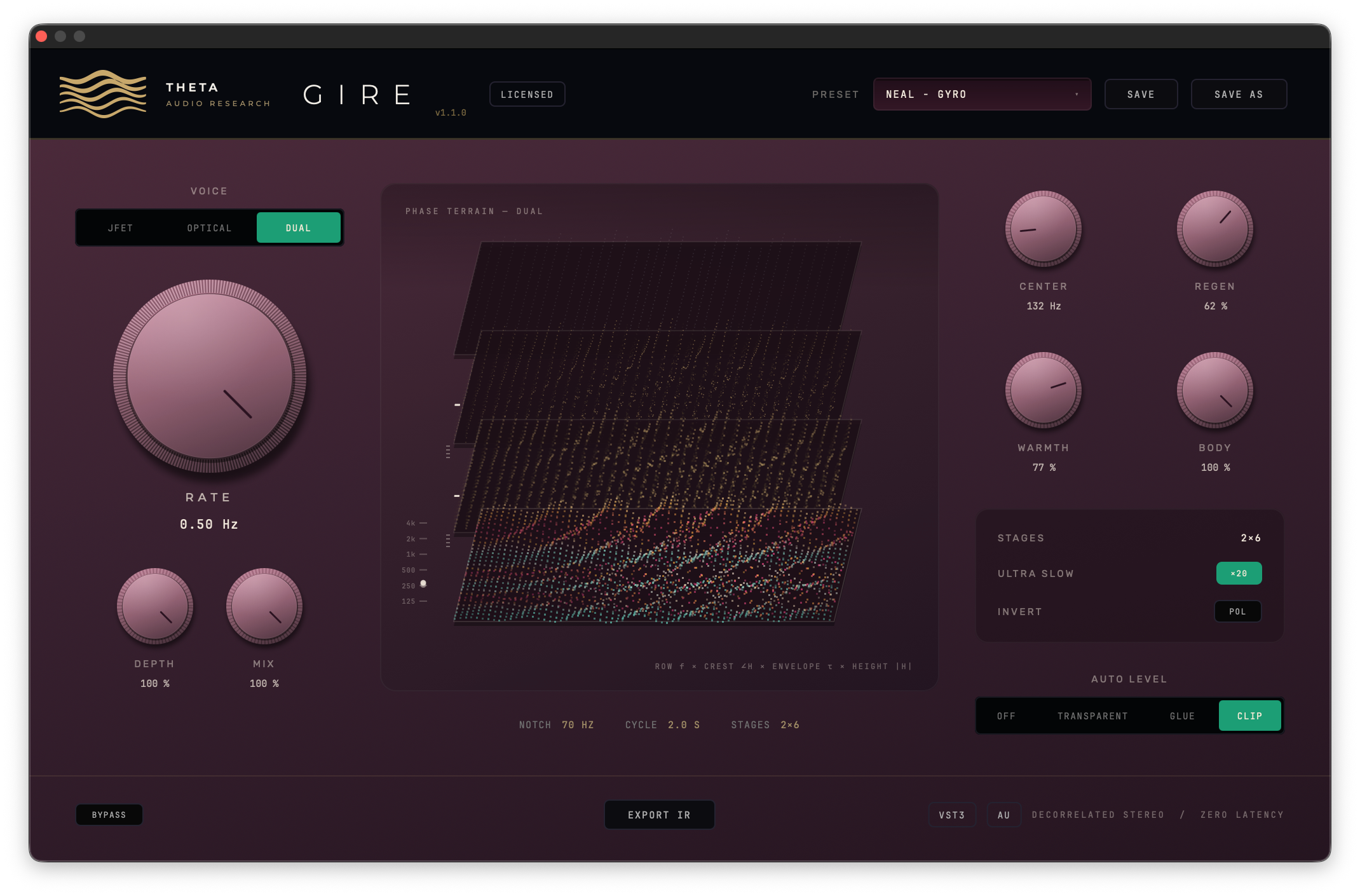
The GIRE panel on DUAL: RATE, DEPTH and MIX on the left, the phase terrain in the middle with NOTCH 70 HZ, CYCLE 2.0 S and STAGES 2×6 under it, CENTER, REGEN, WARMTH and BODY on the right, and AUTO LEVEL set to CLIP
How it works

A phaser passes your signal through a chain of allpass stages. An allpass stage leaves every frequency at the same level and changes only its timing: each one lags the signal by a quarter turn at its own break frequency, and less above and below. Chain four and the lag reaches half a turn at two frequencies.

Mix that back with the dry signal and those two frequencies cancel. That is a notch. Sweep the stages up and down and the notches travel through the spectrum, which is the sound everyone recognises as phasing.

Everything else in GIRE decides what those notches do. VOICE chooses the network. RATE, DEPTH and CENTER move it. REGEN feeds the network's output back to its input so the peaks between the notches ring. WARMTH makes the components disagree. BODY keeps the lows out of it, MIX sets how deep the notches cut, and AUTO LEVEL takes the level out of the comparison.

Every picture on this page is computed from that network, so what you see move is what the plug-in does.

IN BODY150 Hz REGEN · SOFT-LIMITED · DAMPED 6 → 2.5 kHz DRY LOWS MIX AUTO LEVEL4 MODES CEILING0 dBTP OUT
  1. 1SPLIT

    BODY decides how much of the band below 150 Hz goes into the network. At 100% all of it does.

  2. 2SHIFT

    Four allpass stages on JFET and OPTICAL, twelve on DUAL, each one lagging the phase around its own frequency.

  3. 3RING

    REGEN feeds the stages' output back to their input, through a soft limiter and a damper.

  4. 4CANCEL

    MIX blends the shifted signal against the dry one. Where they are half a turn apart, they cancel.

  5. 5LEVEL

    AUTO LEVEL matches the output to the input, and a true-peak ceiling keeps it under 0 dBTP.

The notch lab

This is GIRE's network running in your browser, drawn as the response a steady tone would meet at every frequency. The bright line is the left channel and the faint one is the right. The ticks along the top are the stage frequencies, and the colour follows the plug-in's own terrain scale: cyan where it cuts, paper where it leaves the sound alone, amber and rose where it rings.

NOTCH-CYCLE-STAGES4DEEPEST CUT-HIGHEST PEAK-
LEFTRIGHTDRY · 0 dBMODEL OF THE ENGINE AT 48 kHz · SMALL-SIGNAL
The three voices

Each picture traces where a voice's stages sit over the last few seconds, low frequencies at the bottom, running at 0.8 Hz so the shape of the sweep shows. Switching voice takes effect on the next block, and the display redraws to match.

JFET4 MATCHED STAGES

Four matched first-order allpass stages and a smooth sine sweep. With WARMTH up, the stage coefficient is mildly signal-dependent, so hard playing pulls the sweep slightly lower and wider instead of holding one fixed width. This is the sound your ear supplies when someone says "phaser": the circuit inside the small orange box that was most people's first one.

OPTICAL4 STAGGER-TUNED · LAMP AND CELL

Four stagger-tuned stages at fixed multiples of the swept centre, driven through a lamp and a photocell rather than a clean LFO. The lamp warms with a 45 ms time constant and cools with a 120 ms one. The cell responds on a curve, not a line, and each stage's cell lags slightly differently; WARMTH widens how differently. The sweep rises a little faster than it falls, so the way up and the way down are not mirror images, which a sine cannot manage. At default settings the two passes differ by about a tenth of an octave, up to a fifth at full depth. At the slowest rates the lamp keeps up and the difference all but disappears.

DUAL2 × 6 STAGES · 12° APART

Two six-stage machines in series per channel, twelve poles, their LFOs a fixed 12 degrees apart. Each machine has its own feedback loop, limiter and damping. It is wide: parked at CENTER 640, its six notches spread from 84 Hz to 4.7 kHz, where JFET's two sit at 265 Hz and 1.5 kHz. It is the deliberate choice, not the default: on a dense mix four stages is usually all the network a track will take.

The stage count lives in the DSP where it belongs, shown in the panel, never sold as a knob.

The controls

Press SHOW IN THE LAB on any card and the notch lab above sweeps that control through its range, so you can watch what it does to the network. MIX, REGEN, WARMTH and BODY glide over 20 ms too, so every control automates without steps. Double-click a knob to return it to its default, or double-click its value to type a number.

RATE · ULTRA SLOW

0.01 to 10 Hz, weighted so most of the throw lives in the slow half. This is the hero control because slow is the signature. ULTRA SLOW divides the rate by twenty. At the bottom of the range that is one sweep every 33 minutes: movement you feel across an arrangement rather than hear as an effect. The readout always shows the effective rate.

DEPTH · CENTER

DEPTH sweeps up to 2.4 octaves; CENTER runs 100 Hz to 8 kHz. At DEPTH zero the sweep parks, leaving a fixed set of notches you place by ear with CENTER: two on JFET and OPTICAL, six on DUAL. Both are smoothed inside the engine, so automating either never zippers.

REGEN

0 to 95% resonance, soft-limited inside the feedback loop, with high-frequency damping that tightens from 6 kHz to 2.5 kHz as WARMTH rises. It gets sharp and vocal; it never turns into the thin digital scream.

WARMTH

It is not an EQ. Inside the network it widens the mismatch between stages, deepens the JFET nonlinearity, drives the feedback loop harder and tightens its damping as it goes. After the stages it adds a gentle second-harmonic tilt to the wet signal. A −6 dBFS, 1 kHz tone through JFET's wet path at full WARMTH measures 0.35% THD.

BODY

A phase-coherent split at 150 Hz. At 100%, the default, the whole band goes through the network. Turn it down and less of the low end goes through, so a low fundamental barely moves while everything above it keeps swirling. On TWELVE POLE, a 62 Hz fundamental moves more than 20 dB across the sweep at BODY 100. At BODY 55 it moves about 5 dB, and at BODY 0 about 3 dB. Through all three settings, 2.2 kHz keeps moving about 12 dB.

MIX · INVERT

A linear crossfade, where 50% is the classic full-phase sound. INVERT flips the wet polarity, so peaks become notches.

The two channels

There is no spread knob; each voice sets its own. The right channel runs the same sweep a fixed distance ahead of the left: 10 degrees on JFET, 12 on OPTICAL, 15 on DUAL. It sweeps around a centre 1.5% higher, with its own component calibration and, in OPTICAL, its own lamp and cell.

Neither channel is ever inverted against the other, so at ordinary settings a fold to mono costs you the image, not the signal. At default JFET settings a mono fold keeps 99.6% of a channel's level. Pushed hard it costs more: DUAL at full depth and 90% regen keeps about three quarters on average, dipping to about a third at the deepest points of the sweep.

Mono in, stereo out opens a single guitar into a phased image, with the left and right sweeps running a few degrees apart around slightly different centres.

R CENTRE × 1.015
The phase terrain

The picture in the middle of the panel is not an animation. Each of its 32 rows is one tone burst at one frequency, on a log scale from 60 Hz at the front to 8 kHz at the back. The circuit you are running bends each burst: the crests shift by the phase lag at that frequency, and the envelope slides by the group delay. On the front sheet, height is the output level. A notch shows as a flattened cyan row, and a resonance as an amber ridge that turns rose as it builds.

MIX pulls the stack apart. DRY sits at the back. In front of it is the network's first pass, one sheet per machine on DUAL, with the feedback loop's recirculations drawn as fainter traces behind it, one per pass. OUT is at the front, with the right channel printed over it at half density; where the two channels notch differently, the notch rows double. At MIX 0 there is one intact image.

The stage frequencies and loop gain come from what the engine ran in the last block, not from where the knobs point. At fast rates the picture trails the LFO by the circuit's own smoothing, and further on OPTICAL, whose lamp is slow. With REGEN up, drive the plug-in hard and the ridges drop as the loop's limiter takes hold. It follows VOICE, CENTER, DEPTH, RATE, ULTRA SLOW, REGEN, WARMTH, BODY, MIX and INVERT, and each row's brightness follows the audio you feed it at that frequency.

Drag the picture down to flatten the rows toward edge-on, where the stack reads as bare layers. Drag up, or double-click, to stand it back up. The angle stays where you left it when you close the window, and loading a preset leaves it alone.

A frequency scale at the left edge carries two pips that show where each channel's sweep sits right now. Under the picture, NOTCH names the first notch being cut at this point in the sweep, CYCLE gives the length of one sweep, and STAGES gives the voice's layout. A test in our evaluation harness holds the display's response model against the plug-in's measured impulse response at 60 parked settings. The first notch must agree within 4%; the worst case today is 3.87%, and the NOTCH readout lands within 1% of the notch the picture draws.

Auto level

Four buttons at the bottom right of the panel: OFF, TRANSPARENT, GLUE and CLIP. A phaser gets louder as REGEN climbs and loses level in its notches as MIX rises, so an A/B made while you dial it in is rigged toward the louder setting. AUTO LEVEL matches the output back to the level coming in, so your ear judges the phasing, not the volume, and holds a −0.3 dBFS ceiling.

TRANSPARENT rides the gain slowly and leaves the sound alone until the ceiling. GLUE adds a gentle 2.5:1 compressor, the way a bus compressor sits on a mix. CLIP drives 9 dB into the ceiling, loud on purpose. Take REGEN from 0 to 90 and the output moves 3 dB with AUTO LEVEL off, and about a tenth of a dB with it on. Changing mode fades over 10 ms, so it never clicks.

After it, a true-peak limiter keeps the reconstructed waveform under 0 dBTP, not just the samples under the ceiling, so a converter or a streaming encoder never sees an overshoot. It looks 36 samples ahead, 0.75 ms at 48 kHz, and GIRE reports that latency in every mode, OFF included, so your host lines it up for you. OFF never limits. OFF is the default: sessions and presets saved before 1.1.0 open with it off and sound exactly as they did. It is the same output stage across the Alchemy Index.

LEVEL MOVES 0.1 dB
ILLUSTRATION · THE 3 dB AND 0.1 dB FIGURES ARE MEASURED IN THE RELEASE HARNESS
Export IR

The button under the picture prints the network as it sits right now into an impulse response: a 32-bit float WAV at the host's sample rate, mono or stereo to match the track, ready for any convolver. It asks where to save, offers a name built from the preset, the voice and the rate, and never writes over another file.

AUTO LEVEL is left out, since a level that follows the programme has no impulse response, and exporting never changes a sample of the audio that is playing.

The trace on the right is the first 20 ms of the impulse response of the notch lab's network at the moment you press the button, computed sample by sample.

GIRE IR · JFET · 0.42 HZ
The licence

The trial is the whole plug-in for fourteen days, and the header counts down the days left. After that, a computer that has not been activated goes silent, and the LICENCE card stays over the panel until a licence is activated. In GarageBand and other sandboxed hosts it keeps playing.

The same installer everyone buys, running unlicensed for fourteen days. A licence unlocks it in place, no reinstall.

Activation needs an internet connection once. After that GIRE runs offline, and the licence does not expire. One licence covers three computers. The LICENCE card shows who the copy is licensed to, and DEACTIVATE THIS COMPUTER frees its seat, so you can move GIRE to a new machine without writing to us.

Once activated, GIRE is never silenced by a licence check. After a hardware change or a system reinstall it keeps playing, and the header reads REACTIVATE until you enter your key again.

Who it is for
GUITARISTS

The mid-seventies four-stage sound is a preset, and BODY means you can put a phaser on a down-tuned riff without losing the low end. SLOW BLOOM is voiced for low-tuned parts from the start.

PRODUCERS & SOUND DESIGNERS

DUAL at ultra-slow rates is a movement layer whose cycle outlasts most sections. Set DEPTH to zero and the sweep parks into a fixed set of notches you tune by hand with CENTER, then print them with EXPORT IR.

MIX ENGINEERS

Stereo movement that survives a mono fold, a resonance control that stays musical at 95%, and AUTO LEVEL so pushing REGEN never wins an A/B on volume alone.

SCORE & AMBIENT

A 33-minute sweep is a structural device, not an effect. Set it and let a cue breathe across its whole length.

Technical specifications
TYPEThree-voice analog-modelled phaser (insert)
VOICESJFET (4 matched stages) · OPTICAL (4 stagger-tuned stages, lamp and photocell) · DUAL (2 × 6 stages in series, machines 12° apart)
STEREORight channel offset 10–15° by voice, never inverted left against right. Mono to mono, mono to stereo, stereo to stereo
OUTPUTAUTO LEVEL: OFF · TRANSPARENT · GLUE · CLIP, −0.3 dBFS ceiling, held under 0 dBTP
EXPORTImpulse response as a 32-bit float WAV at the host's rate
LATENCY36 samples in every mode (0.75 ms at 48 kHz), reported to the host
PRESETSSix factory sounds (INIT, SMALL ORBIT, SLOW BLOOM, GLASS SWIRL, TWELVE POLE, VAPOR TRAIL); user presets with save and save as, shared across your Mac hosts
LICENCE14-day full trial · one licence, three computers · activate once online, then runs offline · perpetual
FORMATSVST3 · Audio Unit · AAX (Pro Tools)
SYSTEMmacOS 11 or later · Apple Silicon and Intel (universal)
Windows (VST3): coming soon

GIRE shares its AUTO LEVEL output stage with the rest of the Alchemy Index, so level-matched A/Bs work the same way across THETA's plug-ins.

GIRE's voices are original models inspired by classic hardware circuits. All product names referenced are trademarks of their respective owners, and no affiliation or endorsement is implied.

Deployment status
GIRE

GIRE is calibrated and available for immediate deployment. All three voices, the full panel, nothing withheld.

$50$25

Launch sale. Use code ALCHEMY50 at checkout. The trial is the same installer, unlicensed for fourteen days; a licence unlocks it in place, no reinstall.

MACOS APPLE SILICON AND INTEL · VST3 / AU / AAX INCLUDED · WINDOWS COMING SOON